
Altamonte Springs City Directory Collections on Record
The verified shelf is small but unusually useful. Two scanned early volumes show Altamonte under different county and publishing frames, while later regional microfilm confirms that the city continued to appear inside broader north-Orlando runs. Exact local shelf holdings for telephone, reverse, and criss-cross books were not established, so those should be requested from reference staff rather than assumed.
| Collection | Years | Keeper or publisher | Access |
|---|---|---|---|
| Orange County and Orlando City Directory | 1913 | Directory Publishing Co.; source copy from Orange County Library System | Free UCF STARS scan; 238 pages and an Altamonte locality list |
| Sanford City Directory | 1917-1918 | R. L. Polk & Co.; source copy from Sanford Museum | Free UCF STARS scan with name, street, and business sections |
| Orlando Suburban directory microfilm | 1978, 1979 | Publisher unverified; Gale reel 23 | Coverage is indexed; confirm a reading location before visiting |
| Orlando North Area directory microfilm | 1988 | Publisher unverified; Gale reel 22 | Altamonte coverage verified; reading location remains to be confirmed |
| State Library city directories | Early 1900s to present statewide | Multiple publishers | Onsite reference in Tallahassee; confirm exact Altamonte titles first |
The Museum of Seminole County History also holds assorted directories, maps, papers, photographs, local newspapers, and family histories. Its official material recommends arranging research access, but no authoritative title-by-title Altamonte inventory was found.
Why Altamonte Springs City Directory Titles Change After 1913
The county name on an old book is a research clue. Florida created Seminole County from Orange County on April 25, 1913. The 1913 volume therefore correctly appears as an Orange County and Orlando directory, while the 1917-18 Polk book is centered on Sanford in the new Seminole County. Pre-1913 land, court, and local administrative clues may likewise point back to Orange County predecessor records.
This shift is why a catalog search limited to “Altamonte Springs” can miss the best city directories. Ask for Sanford, Orlando Suburban, Orlando North Area, Polk, telephone, and criss-cross titles as well.
How to Read an Altamonte Springs City Directory Entry
Entry detail changes by volume. The 1913 locality list is alphabetical and often uses initials, short household phrases, “Mrs.” or widow conventions. Many lines do not give a street address or occupation. The fuller 1917-18 volume supports an alphabetical name route, a street route, and a classified business route, but every symbol must be read through that book's own key.
| Name form | Surname with initials or an abbreviated given name; women may appear independently or under period household wording. |
|---|---|
| Household clue | A phrase such as “and wife” suggests a household link but may omit the wife's given name. |
| Address | Often absent in the sparse 1913 locality list; later street sections can place entries in address order. |
| Work or trade | More likely in fuller alphabetical or classified sections than in the early locality list. |
| Status mark | Period widow or spouse language can guide a census, death, newspaper, or probate search. |
- Criss-cross directory
- A later directory arranged by street or telephone number instead of only by surname; exact Altamonte shelf years are unverified.
- Householder index
- A name or address finding aid that identifies listed householders, not every person at an address.
- Abbreviation key
- The publisher's guide to shortened names, trades, residence marks, streets, and other codes used in that edition.
Two Search Routes Through the 1917-18 Altamonte City Directory
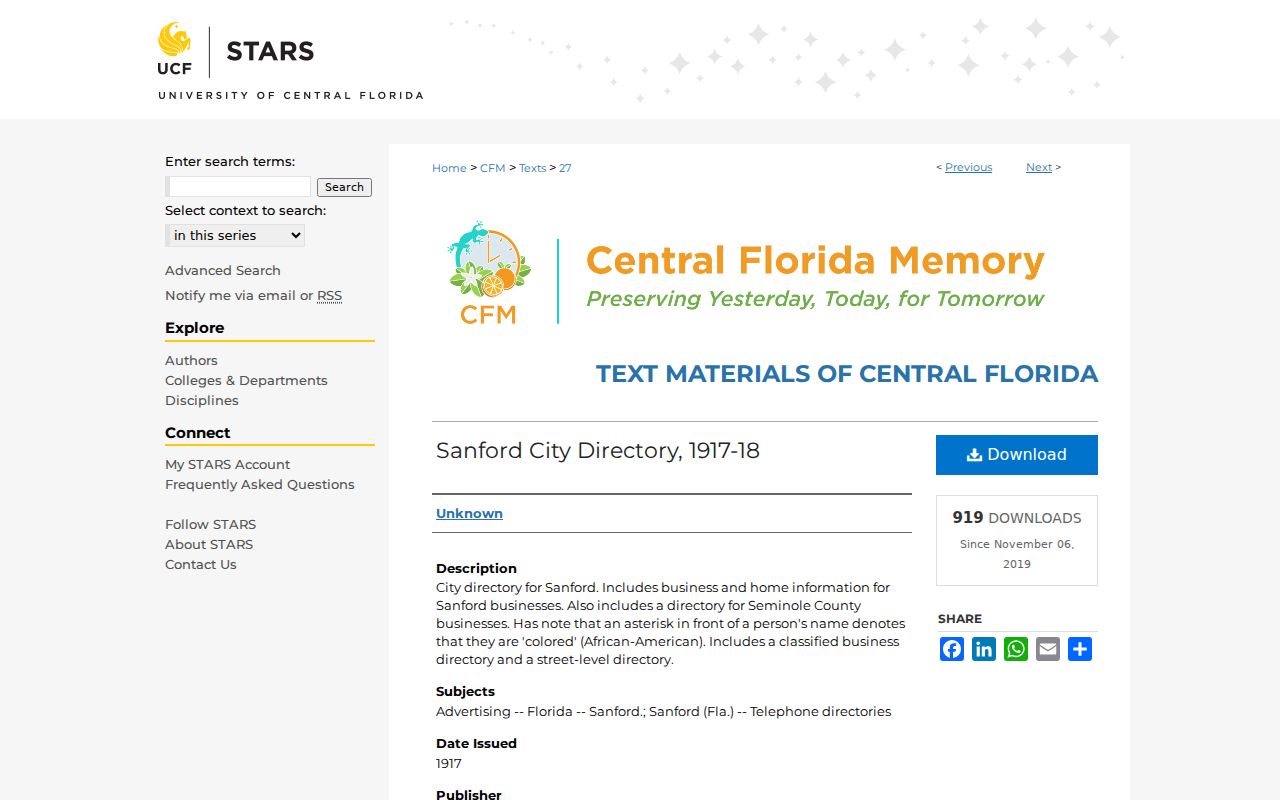
The digitized Polk volume is stronger than a simple surname scan. Its street directory begins around page 23, the abbreviation and alphabetical-name material around page 43, and the classified business section around page 123. A name can lead toward an address, while a street sequence can reveal other listed entries nearby. The business section can add a trade or firm connection without proving where anyone lived.
The UCF-hosted 1917-18 directory scan shows these routes in the original volume.
Keep the page image, volume title, page number, and exact transcription together so another researcher can audit the match.
The Altamonte Springs City Directory Asterisk Needs Context
The 1917-18 Polk index used an asterisk to identify African-American residents. That was a discriminatory historical indexing practice, not a neutral classification and not language to carry into a modern list. A faithful transcription can preserve the mark because it helps locate the original entry, but the research note should explain what the publisher did and why the convention is harmful.
Reading rule. Preserve enough of the original notation to find the source, then describe biased period conventions in clear historical context.
This caution matters because directories reflect who was canvassed, how publishers classified people, and whose names they omitted. Absence from a city directory never proves that a person was absent from Altamonte Springs.
Trace a Family Across Altamonte Springs City Directories
A sound family-history search treats each listing as one dated clue and pairs it with a source created for a different purpose. Directory years bridge the long gap between federal census schedules, while census, obituary, probate, deed, cemetery, and church records test the identity suggested by a name line.
- Search the surname, initials, married or maiden forms, and likely spelling variants in each available directory.
- Transcribe the whole line, the heading, the page, and the abbreviation key rather than copying only the name.
- Use the street section when available to test the address and nearby listed households.
- Carry the household clues into the 1920 census, then compare later directories and the public census schedules through 1950.
- Use newspapers, obituaries, cemetery records, probate, and deeds to explain a disappearance or family transition.
A missing entry can mean a move, death, publication lag, rural coverage, a changed surname, or a missed canvass. It is not a conclusion by itself. For present-day verification after a historical find, the Altamonte Springs resident lookup workflow shows how to corroborate one person in official indexes.
Library Paths Beyond the Altamonte Springs City Directory
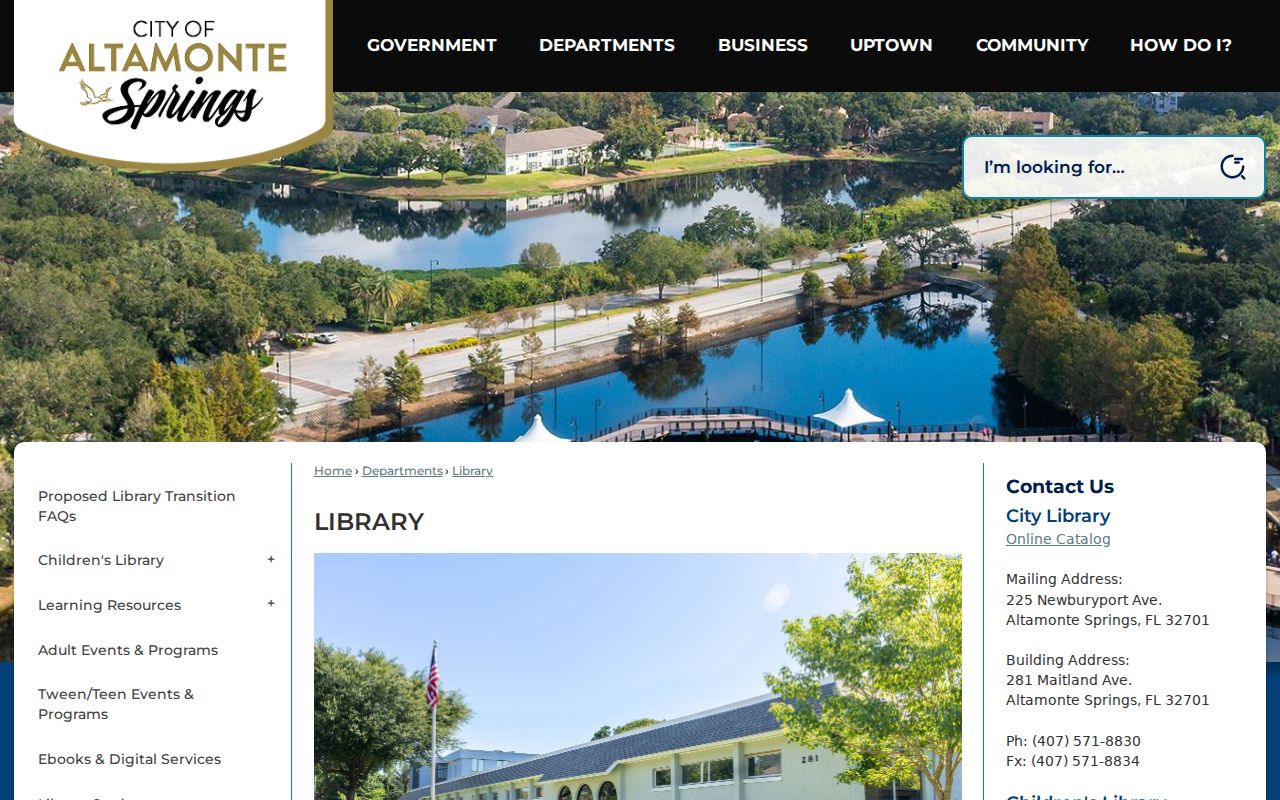
The Altamonte Springs City Library has a broad current collection and local reference help at 281 Maitland Avenue. Published hours are Monday through Thursday, 10 a.m. to 7 p.m., and Friday and Saturday, 10 a.m. to 4 p.m.; the main research contact is 407-571-8830. A city proposal describes a possible physical-library transition on September 30, 2026, so confirm current service before a visit and do not treat the proposal as completed.
Seminole County Library adds Ancestry Library Edition onsite, HeritageQuest, FamilySearch, GenealogyBank, HeritageHub, Central Florida Memory, and Florida Memory. HeritageHub reports aggregate newspaper content from 1704 forward, but no official page established exact Altamonte newspaper-title or obituary-index years. Reference staff should confirm a title run before it is cited.
The city library's official page gives current service details and contacts.
For regional holdings, also contact the Jean Rhein Central Branch, the Museum of Seminole County History, or the State Library before planning a research trip.
Altamonte Springs City Directories Meet Community Memory
Names in printed city directories gain depth through UCF RICHES, Central Florida Memory, and the Museum of Seminole County History. RICHES includes images, documents, and oral histories, including Bob Hattaway's account of growing up around the fern industry. UCF's 2023 Altamonte Springs Rosenwald School History Harvest preserved community-held items and oral histories that may never appear in a government index.
The scale change is striking. The 1913 directory described a locality of about 200 people, while the Census Bureau's 2025 estimate is 48,000. Modern Altamonte also has a large multifamily population, so neither an old printed volume nor a modern owner roll can be treated as a complete resident list.
Evergreen Cemetery offers another local thread. The city dates its founding by Laura and William Brawner to the 1890s as a burial place for Black residents and records pioneer trustees and later restoration work. No official searchable interment index was found, so a name lead should move to cemetery, church, obituary, and archival contacts without inventing online coverage.